Braille and Tactile Materials for Special Children are more than educational tools; they are doorways to independence, literacy, and confidence. For a child who is blind, visually impaired, or has a learning difference, the ability to touch, feel, and read through their fingertips can be just as powerful as any printed book or classroom screen. Yet many parents and educators are unsure where to begin. What exactly counts as a tactile material? How does Braille work for young children? Which tools are most effective, and at what age should they be introduced? This guide answers every one of those questions clearly and practically.
Braille and Tactile Materials for Special Children are now backed by decades of research in special education, occupational therapy, and disability science. Whether your child is newly diagnosed or has been learning with assistive tools for years, this article will give you the knowledge to move forward with confidence.
What Are Braille and Tactile Materials? A Simple Definition
Braille is a tactile writing system made up of raised dots arranged in patterns that represent letters, numbers, punctuation, and even music. It was invented by Louis Braille in 1824 and remains the gold standard of literacy for people who are blind or have severe visual impairment.
Tactile materials go beyond Braille. They include any learning resource that uses texture, shape, or raised surfaces to convey information. Together, Braille and Tactile Materials for Special Children form a complete literacy and learning ecosystem, one that addresses reading, exploration, communication, and academic development.
Common Types of Braille and Tactile Materials
- Braille books printed texts reproduced with raised Braille dots for independent reading
- Embossed maps, geographic and spatial maps with raised lines, textures, and labels in Braille
- Tactile diagrams, scientific, mathematical, or artistic diagrams rendered with raised lines and textures
- Tactile picture books, early childhood books, where images are created using different textures
- Braille flashcards, learning cards for letters, numbers, and vocabulary in Braille
- Thermoform sheets, plastic sheets, embossed with diagrams or images for hands-on exploration
- Tactile puzzles and spatial puzzles are designed for touch-based learning
- Braille labels, adhesive labels in Braille for labeling everyday objects at home and school
Why Braille and Tactile Materials Matter for Special Children
Research consistently shows that children who learn Braille early develop stronger literacy, greater independence, and higher employment rates as adults compared to those who rely solely on audio tools. The National Federation of the Blind reports that Braille literacy is one of the strongest predictors of long-term success for blind individuals.
For special children with visual impairment, Braille and Tactile Materials are not a last resort; they are a first-line literacy tool. And for children with other learning differences, including autism spectrum disorder or sensory processing difficulties, tactile learning materials can dramatically improve engagement, comprehension, and focus.
Consider this: a seven-year-old girl with congenital blindness was introduced to Braille books and tactile diagrams at age four. By age seven, she was reading independently at grade level, something her teachers had initially considered unlikely. Braille and Tactile Materials for Special Children, introduced early and consistently, can exceed even cautious expectations. You can also share your story with us.
How Braille Works: A Parent-Friendly Explanation
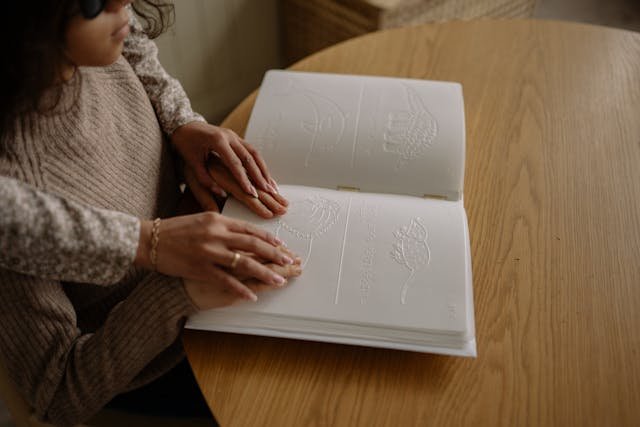
Braille uses a cell of six raised dots arranged in two columns of three. Each combination of raised and flat dots represents a different letter, number, or symbol. There are 64 possible combinations in a standard Braille cell.
The Two Grades of Braille
- Grade 1 Braille (Uncontracted): Each Braille cell represents one letter or number, ideal for beginners and young children
- Grade 2 Braille (Contracted): Uses special combinations to represent whole words or common letter patterns, faster to read and more compact
Most children begin with Grade 1 Braille and progress to Grade 2 as their fluency grows. Braille and Tactile Materials for Special Children are available in both grades, and a certified Teacher of the Visually Impaired (TVI) can guide the transition.
Braille for Different Subjects
- Nemeth Code specialized Braille system for mathematics and science notation
- Music Braille notation system for reading and writing music
- Computer Braille (Unified English Braille) adapted for digital screen-reader compatibility
This range means Braille and Tactile Materials for Special Children can support learning across every school subject, not just language arts.
Exploring Key Tactile Materials for Special Children in Depth
1. Braille Books
Braille books are the foundation of tactile literacy. They range from simple picture books for toddlers to complex novels and textbooks for older learners. Publishers like the American Printing House for the Blind (APH) and National Braille Press produce thousands of titles across grade levels and subjects. Dual-format books, which contain both printed text and Braille, are particularly powerful for inclusive family reading. Parents who do not read Braille can follow along with the print while their child reads the Braille version independently.
2. Embossed Maps
Embossed maps use raised lines, textures, and Braille labels to represent geographic features. They help special children understand spatial concepts, where countries are, how rivers flow, and what a city grid looks like through touch rather than sight. Geography lessons become tactile experiences. A child can trace a mountain range with their finger, feel the difference between a river valley and a plateau, and read the Braille labels for country names. Braille and Tactile Materials for Special Children, like embossed maps, are proven tools for building spatial reasoning skills.
3. Tactile Diagrams
Science, technology, engineering, and mathematics all rely heavily on diagrams, cell structures, geometric shapes, circuit diagrams, and more. Tactile diagrams reproduce these visuals using raised lines, varied textures, and Braille annotations. Organizations such as the Royal National Institute of Blind People (RNIB) and View-Plus Technologies produce high-quality tactile diagrams for STEM subjects. These materials ensure that children with special needs are not excluded from science education simply because of visual impairment.
4. Tactile Picture Books for Early Learners
Before formal Braille instruction begins, young special children benefit enormously from tactile picture books. These books feature textured pages where a cat’s fur feels soft, a tree’s bark feels rough, and a ball feels smooth and round. Tactile picture books build sensory awareness, vocabulary, and the foundational concept that objects can be represented symbolically in a critical precursor to reading and writing systems. Braille and Tactile Materials for Special Children should ideally begin in infancy or toddlerhood with these sensory-rich books.
How to Introduce Braille and Tactile Materials to Special Children: Step by Step
Starting Braille and tactile learning can feel daunting. Here is a practical, stage-based approach used by special education specialists worldwide.
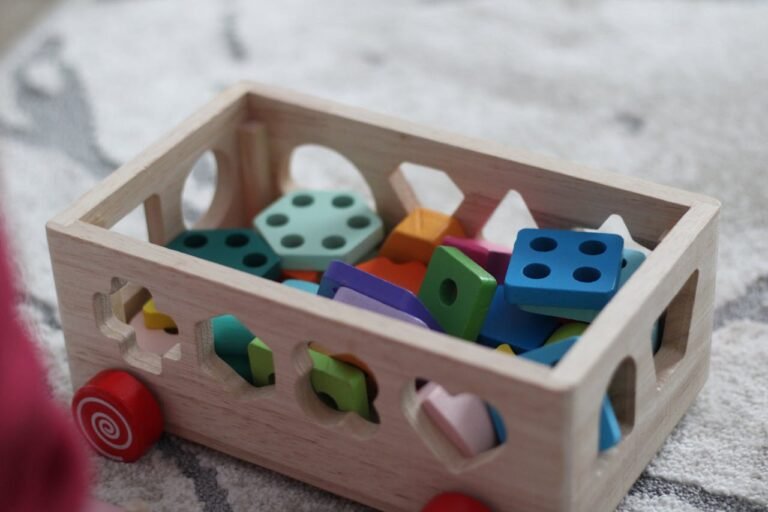
- Start with sensory play, introduce varied textures through toys, fabrics, and food, long before formal literacy tools
- Moving to tactile picture books builds associations between textures and objects or concepts
- Introduce the Braille alphabet, use Braille flashcards, and hands-on alphabet boards
- Begin Grade 1 Braille reading by using high-contrast Braille books with large, well-spaced cells
- Add tactile diagrams to science, math, and social studies lessons
- Introduce embossed maps start with simple maps of familiar spaces like the classroom or neighborhood
- Progress to Grade 2 Braille as fluency increases, and contracted Braille speeds up reading significantly
- Incorporate technology, pair physical materials with Braille displays and screen readers for a complete learning environment
This progression reflects best practices from organizations like Perkins School for the Blind and the American Foundation for the Blind. Braille and Tactile Materials for Special Children work best when introduced gradually and consistently, with professional guidance from a certified TVI.
Using Braille and Tactile Materials at Home and School
At Home
The home environment is where Braille literacy is reinforced daily. Parents can make a significant impact with simple strategies:
- Label household objects with Braille stickers: the refrigerator, bedroom door, toy box
- Read dual-format books together at bedtime
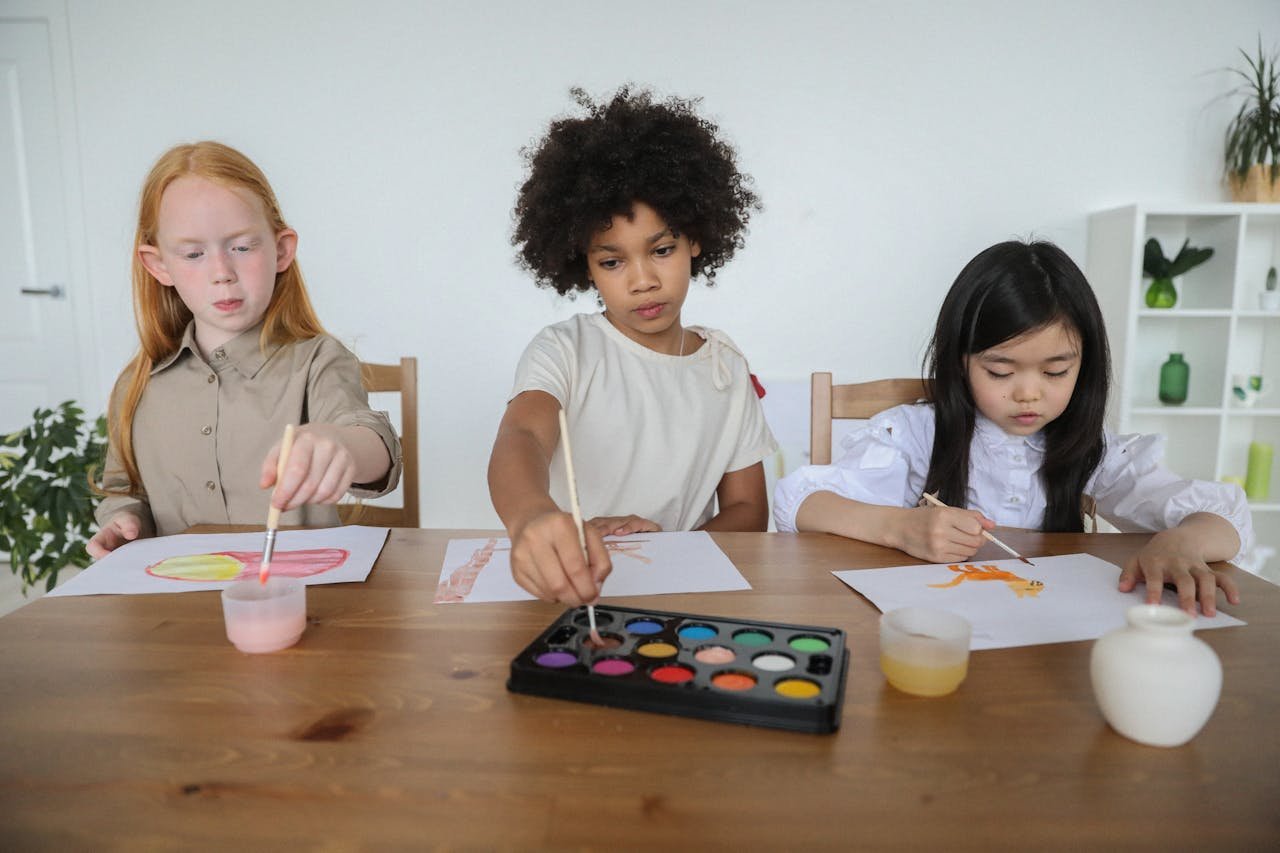
- Provide tactile art supplies, clay, textured papers, and foam sheets for creative exploration
- Use tactile calendars and schedules to build independence and time awareness
- Create a dedicated quiet, low-distraction space for tactile reading and learning
At School
In the classroom, inclusion depends on having the right materials and the right mindset. Teachers working with special children should:
- Request Braille versions of all textbooks and worksheets through the school’s TVI
- Provide tactile diagrams for every visual element taught in class
- Use embossed maps in geography and social studies
- Allow extended time for tactile tasks. Reading and writing in Braille takes longer initially
- Integrate Braille and tactile tools into the child’s Individualized Education Program (IEP)
If you are looking for a broader range of practical support tools, our guide on top assistive tools for special children covers everything from communication devices to sensory aids, many of which pair powerfully with Braille and tactile learning.
Technology That Supports Braille and Tactile Learning for Special Children
Modern technology has transformed how Braille and Tactile Materials for Special Children are produced and used. Today’s tools make tactile literacy more accessible, affordable, and engaging than ever before.
- Braille embossers and printers that produce Braille on paper are used in schools and homes to create custom materials
- Refreshable Braille displays electronic devices with raised pins that display Braille text from digital sources in real time
- Tactile graphics producers use devices like the Swell Form machine that create raised diagrams from printed images
- Braille note-takers are portable devices that allow children to write, read, and store notes in Braille
- 3D printing is increasingly used to create custom tactile diagrams, models, and learning objects on demand
- Screen readers with Braille output software that converts digital text to Braille display output for seamless digital access
Braille and Tactile Materials for Special Children are evolving rapidly. The combination of traditional physical materials and modern assistive technology gives every child the best possible foundation for lifelong literacy.
How to Choose the Right Braille and Tactile Materials for Your Special Child
Every child is different. Choosing the right materials depends on age, diagnosis, sensory profile, and learning goals. Here are the key factors to consider:
- Age and developmental stage, younger children need sensory-rich tactile books; older learners need grade-appropriate Braille texts
- Degree of visual impairment, children with some residual vision may use both print and Braille (dual media approach)
- Sensory sensitivities, some children with autism or sensory processing differences may need materials with specific textures
- Subject area: choose embossed maps for geography, tactile diagrams for science, Braille flashcards for literacy
- Professional guidance always works with a certified Teacher of the Visually Impaired to select and sequence materials
Braille and Tactile Materials for Special Children are not one-size-fits-all. The most effective approach is individualized, built around each child’s unique needs, strengths, and learning pace.
Conclusion: Braille and Tactile Materials Are a Gateway to Independence
Braille and Tactile Materials for Special Children are among the most powerful educational investments a parent or educator can make. From the first tactile picture book to a full library of Braille texts and embossed maps, these tools give children the ability to read, explore, learn, and eventually live independently. The evidence is clear, the tools are available, and the impact is profound. Braille and Tactile Materials for Special Children do not limit possibility they multiply it. Every raised dot, every textured page, every embossed diagram is a step toward a child who can navigate the world on their own terms.
Frequently Asked Questions (FAQ)
Optimized for Google’s People Also Ask answers to the most searched questions about Braille and Tactile Materials for Special Children.
At what age should a child start learning Braille?
Most specialists recommend introducing tactile awareness and early tactile books from infancy, with formal Braille instruction beginning between ages three and five the same window as print literacy for sighted children. Early introduction of Braille and Tactile Materials for Special Children produces the strongest long-term literacy outcomes.
Can children with some vision still benefit from Braille?
Yes. Children with low vision or progressive eye conditions often benefit from a dual media approach, learning both print and Braille simultaneously. This ensures they have strong literacy skills regardless of how their vision changes over time. Braille and Tactile Materials for Special Children with partial sight are just as important as for fully blind children.
What is the difference between Grade 1 and Grade 2 Braille?
Grade 1 Braille assigns one Braille cell to each letter or number. It is the entry point for beginners. Grade 2 Braille uses contractions and abbreviations to represent common words and letter combinations, making reading faster and text more compact. Most Braille books for older readers use Grade 2.
Where can I get Braille books for my child?
Braille books are available through the American Printing House for the Blind (APH), the National Library Service for the Blind and Print Disabled (NLS), Bookshare, and local libraries with accessible collections. Many titles are also available for free through national lending programs. A certified TVI can help you access the right Braille and Tactile Materials for your special child.
Are tactile diagrams available for all school subjects?
Yes. Tactile diagrams exist for science, mathematics, geography, history, art, and more. Organizations like the RNIB, APH, and View-Plus Technologies produce extensive libraries of subject-specific tactile materials. Custom diagrams can also be produced using Braille embossers and tactile graphics devices.
How do I know which tactile materials are right for my child?
The best starting point is a functional vision and learning media assessment conducted by a certified Teacher of the Visually Impaired. This assessment determines your child’s visual capability, sensory profile, and learning needs, forming the foundation of a personalized plan for Braille and Tactile Materials for Special Children.
Can technology replace traditional Braille books and tactile materials?
Technology enhances but does not replace physical Braille and tactile materials. Refreshable Braille displays and screen readers are powerful supplements, but research consistently shows that physical tactile materials develop stronger sensory literacy, spatial reasoning, and reading fluency, especially in young learners.